Services

To ensure the delivery of our services meets identified needs, we have undertaken wide consultation and  taken on board the views and recommendations of a number of sources, including families living with the effects of an acquired brain injury and a range of health professionals. Additionally the Founder of our charity knows what help and support both her and her family needed at the time of her son’s accident.  Unfortunately these were not available.

This means that all our services are developed, not only on a clearly identified need, but from a personal ‘living the nightmare’ perspective.

As such we believe we are in the unique position of providing ‘what people actually need’ as opposed to what people ‘think they need’. Our deeper understanding enables us to develop and deliver services that make a real and measurable difference to the children and families who need us. We believe in:

Aiming Higher: Achieving More

We understand that the rehabilitation journey towards recovery is a marathon and not a short sprint.  Neurological improvements take time and progress is sometimes erratic and frustratingly slow.    We know that short term uncoordinated interventions do not deliver the right outcomes for people; so we offer a range of integrated services for children, young people and their families aimed at supporting them for the long-term.
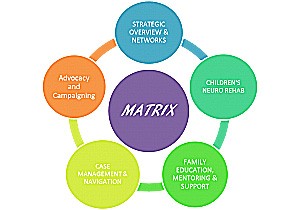
service wheel3

Our services can be accessed in a number of ways:

  • Self referral
  • GP Referral
  • Hospital Referral
  • Community Referral

"Often families don't have the financial capability to access services. We need to rethink how we deliver neuro-rehab services to children and young people"
Vicki Anderson; Australia
"Different 'experts' involved in paediatric neuro-rehabilitation come from different organisational cultures which causes conflict and has a negative effect on the outcomes for the child."
Barbara O'Connell; Ireland
"Parent-supported interventions after paediatric ABI bring reductions to the cost to society"
Eric Hermans; Netherlands
"Taking brain injured children home causes high stress for families. Disjointed services exacerbate family stress levels."
Deborah Andrews; New Zealand
"NHS clinicians struggle with what intervention to prioritise in paediatric neuro-rehabilitation due to limited clinical time and the complexity of needs. Children, clinicians, parents and schools all have different neuro-rehabilitation priorities"
Recolo; United Kingdom
"Thousands of children and young people living in the UK today without the help and support that can make a huge difference to their lives"
Dalton Leong; Chief Executive of the Children's Trust
"We would like to see earlier identification and support for children with brain injuries to help them succeed in school."
Dalton Leong; Chief Executive of the Children's Trust
"Too often children and young people with ABI are discharged from hospital without specialist brain support that they and their families need to overcome lifelong challenges"
Andrew Ross; former Chief Executive of the Children's Trust
"When someone has a brain injury, early access to local, specialist rehabilitation is crucial to ensure the maximum recovery and make significant savings to the state in health costs"
Headway; United Kingdom
I was very impressed with the results you have had with the young people you have worked with.

OUR MISSION: To work to remove inequalities for children & young people affected by acquired brain injury; and provide effective support to their families that makes a real difference to their lives.

Council for Disabled Children Community Funded Charity Excellence Lottery Funded Youth Foundation BBC CiN